
Paid advertising has a particular quality that makes it simultaneously appealing and limiting: the moment you stop paying, the traffic stops. There’s no residual value. No compounding. No asset being built. You’re renting visibility, not buying it.
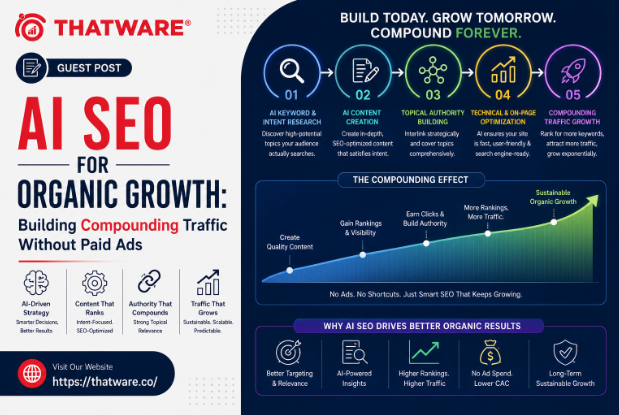
Organic traffic is different. A page that earns a strong ranking position in year one is still producing traffic in year three, often with minimal ongoing investment. The content that earns topical authority this year becomes the foundation that new content ranks on next year. Links acquired today contribute to domain authority that benefits every future page. The whole system compounds — which produces ROI curves that look terrible in month three and extraordinary by month eighteen.
AI-powered organic growth doesn’t make this compounding faster in the early stages. What it does is make the trajectory steeper and more predictable over the full program.
The Compounding Mechanism
To build organic traffic that compounds, you need three things working together: a technical foundation that ensures your pages can be properly indexed and evaluated; topical authority that establishes your domain as a genuine expert resource in your subject area; and content architecture that builds keyword coverage systematically rather than randomly.
Most traditional SEO efforts achieve these things partially and inconsistently. Technical foundations get patched but rarely optimized from a crawl architecture perspective. Content gets produced in response to keyword opportunities without a coherent topical architecture. Authority builds slowly because there’s no systematic approach to coverage completeness.
AI SEO for organic growth builds these three components deliberately and simultaneously. The technical work is guided by impact modeling. The content architecture is mapped from the full semantic landscape before production begins. Authority building follows a plan rather than accumulating by accident.
Why Organic Outperforms Paid Long-Term
The math is worth spelling out explicitly. A paid campaign with a $10,000 monthly budget produces traffic as long as the budget runs. An equivalent investment in organic SEO — spread over twelve months and building authority progressively — produces traffic for years after the investment concludes. The break-even point varies by vertical and competitive intensity, but for most businesses it falls somewhere in the twelve to eighteen month range.
After break-even, every month of organic traffic is effectively free. CAC from organic search drops continuously as the asset matures. The same content that cost $X to produce and rank is producing leads at a fraction of the ongoing cost of a paid campaign delivering equivalent volume.
The Role of Content Quality in Compounding
Low-quality content doesn’t compound. It ranks briefly, declines, and requires replacement. The compounding model depends fundamentally on content that’s good enough to sustain ranking positions for extended periods — which means genuinely addressing search intent, establishing real topical authority, and providing the kind of information value that earns links naturally.
Get AI SEO services decisions should be evaluated partly on whether the content strategy they produce is built for longevity or for quick wins. Longevity content — comprehensive, expert, well-structured, regularly updated — compounds. Quick-win content — thin, short, targeting low-competition terms — produces a short traffic bump and then requires replacement.
Scaling Without Proportional Cost Increase
The most powerful aspect of compounding organic growth is that the marginal cost of additional traffic decreases over time. As domain authority grows, new content ranks faster and for more competitive queries. As topical clusters mature, new additions to the cluster benefit from established authority rather than starting from zero.
This scaling dynamic is what makes organic SEO — particularly AI-powered organic SEO, which builds authority more efficiently than manual approaches — one of the most attractive long-term growth channels available. The businesses that figure this out and commit to building it are the ones that arrive at a competitive advantage that’s genuinely difficult to displace.